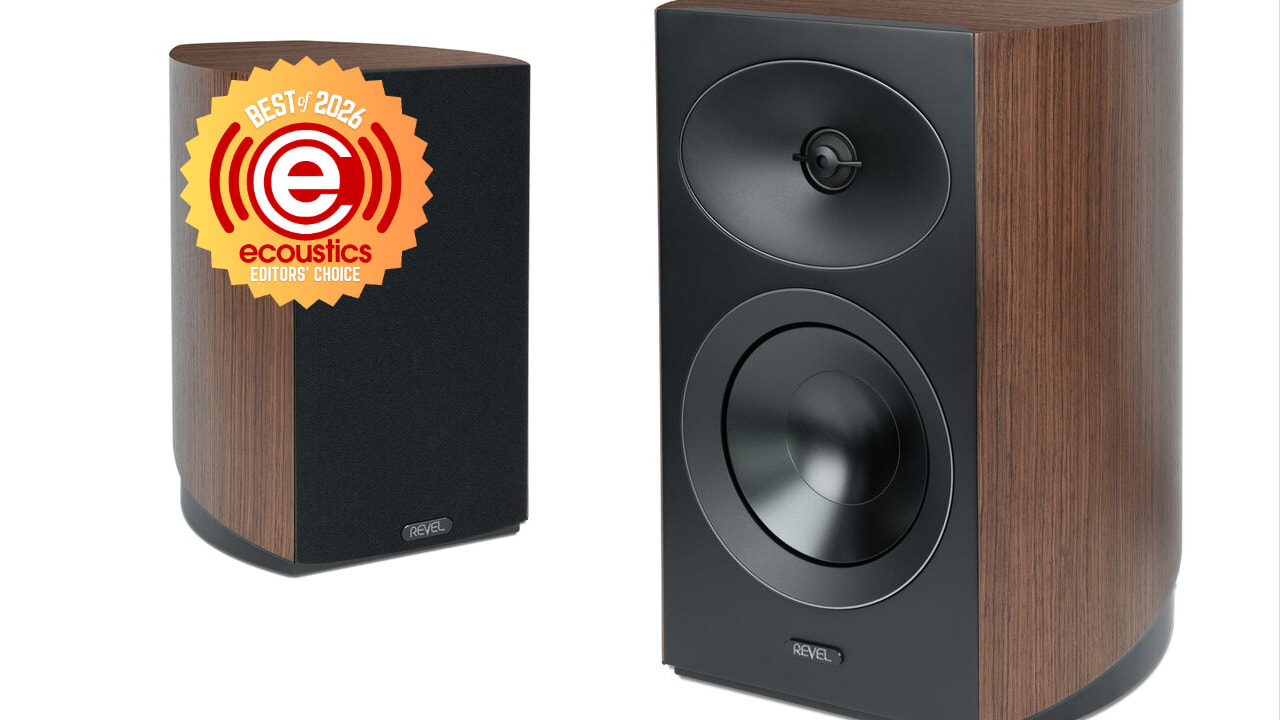
The Revel Performa4 M146 ($2,999 per pair) is the larger of two bookshelf loudspeakers in the company’s new Performa4 series, bringing three decades of acoustic research and engineering into an increasingly competitive segment of the high-end audio market. Revel has never been particularly interested in designing loudspeakers around fashionable materials or whatever sonic characteristics happen to impress listeners during a five-minute showroom demonstration. The company’s reputation was built on the idea that exceptional loudspeakers should deliver measurable accuracy, controlled dispersion, and consistent performance under real listening conditions.
Established in 1996 as part of Harman International, Revel was created to compete at the highest levels of home audio, drawing heavily on the groundbreaking research of Dr. Floyd Toole into loudspeaker measurements, room acoustics, and listener preferences. Equally important was Kevin Voecks, who brought extensive loudspeaker design experience from Snell Acoustics and helped establish Revel’s engineering direction from the beginning. Their complementary contributions helped define a company where controlled listening tests and objective measurements carry considerably more weight than exotic marketing claims. In an industry where some manufacturers still treat specifications as optional reading, that philosophy has served Revel rather well.
Revel’s original Ultima series established its high-end credentials, while subsequent Performa models brought much of that engineering philosophy to more attainable price points. The new Performa4 M146 continues that tradition with a 6.5-inch woofer, 1-inch dome tweeter, seventh-generation Acoustic Lens waveguide, and rear-ported cabinet designed to deliver balanced performance across a wide listening area. Its smaller sibling, the M145 ($1,999/pair), follows a similar approach with a 5.25-inch woofer, giving buyers two bookshelf options within the new lineup.

Revel also offers the matching MFS4 speaker stands ($999/pair), designed specifically for the M146 and M145, with integrated cable management and a construction intended to provide stable support and proper listening height. At this level, the M146 needs to demonstrate more than excellent measurements. Cabinet construction, finish quality, practical usability, and the contribution of the matching stands all matter when buyers have no shortage of excellent alternatives.
For our review, Harman supplied a pair of M146 loudspeakers, the matching MFS4 stands, and an Arcam streamer and amplifier to complete the system. That gave us an opportunity to evaluate the Performa4 M146 as a complete listening setup and determine whether Revel’s longstanding commitment to scientific loudspeaker design translates into the kind of musical performance that makes listeners forget about the measurements and simply enjoy the music.
Related Reading:
Premium Finishes and Stands That Actually Matter
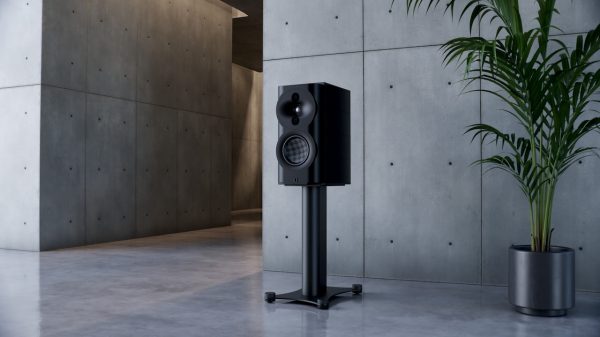
The Revel Performa4 M146 is a relatively large, substantial stand-mount loudspeaker. I hesitate to call it a bookshelf speaker because most bookshelves lack the depth needed to accommodate it properly, much less provide adequate clearance for the rear bass-reflex port. Each cabinet measures 14.1 x 9.7 x 12.7 inches (H x W x D) and weighs 24.3 pounds, making proper support and placement important considerations.

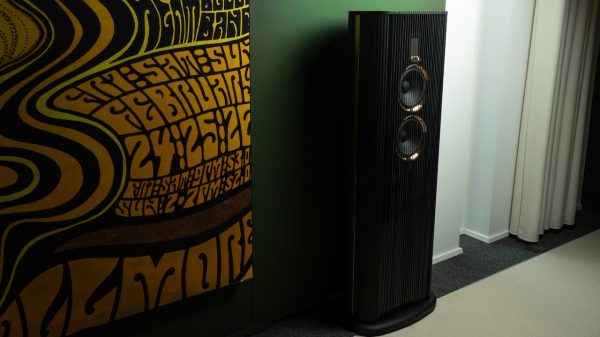
The cabinet features gently curved side panels that reach their widest point near the middle before tapering toward the front and rear. The matte black front baffle provides an attractive contrast to the wood veneer, which is available in Natural Walnut and Black Walnut finishes.
Magnetically attached grilles conceal the drivers without visible fasteners, while the woofer’s hidden mounting flange and integrated trim ring eliminate exposed hardware. The result is a refined, furniture-grade appearance that stands apart from the rectangular boxes dominating much of the stand-mount loudspeaker category.
The quality of the cabinetry, veneer, and finishing details is impressive, although buyers more interested in acoustic performance than aesthetics may question how much of their investment is going toward the furniture. Revel also includes foam port plugs to help control excessive bass reinforcement when placement near walls or cabinetry becomes unavoidable. They proved useful for reducing unwanted bass output, but they’re not a substitute for proper positioning or a solution to every room acoustics problem.

The optional MFS4 stands are considerably more substantial than generic speaker pedestals. Designed specifically for the M146 and smaller M145, they combine extruded aluminum and steel construction with integrated cable management and a secure mounting system that attaches directly to the bottom of each loudspeaker. At 28.7 inches tall and approximately 11.5 pounds each, they provide a stable foundation while complementing the cabinets’ appearance.
I particularly appreciate the screw-mounted design, having witnessed one too many expensive loudspeakers knocked off their stands by careless hands or unfortunate accidents. Nothing is completely immune to gravity, but these are far less likely to become victims of reckless abandon. Revel also supplies carpet spikes and floor protectors, useful accessories that some manufacturers still have the nerve to charge extra for.
Inside the Revel Performa4 M146
The Revel Performa4 M146 is a two-way, bass-reflex loudspeaker built around a 6.5-inch (165mm) Micro Ceramic Composite (MCC) cone woofer. The diaphragm uses an aluminum substrate with a ceramic-based surface treatment designed to increase stiffness and improve damping, helping the cone maintain more linear motion while reducing unwanted resonance and distortion. Revel keeps the exact composition of its ceramic treatment proprietary. The woofer also employs a newly developed cast aluminum frame engineered to improve airflow, cooling, and structural rigidity, while the cabinet’s internal cross-bracing helps control enclosure resonances.

High frequencies are handled by a 1-inch (25mm) Deep Ceramic Composite (DCC) dome tweeter, which also combines an aluminum substrate with a proprietary ceramic treatment. The tweeter sits within Revel’s seventh-generation Acoustic Lens waveguide, designed to control dispersion and maintain a consistent frequency response both on and off the listening axis.
Equally important, the waveguide helps match the tweeter’s dispersion characteristics to those of the woofer through the crossover region, promoting a smoother transition between drivers. Revel has invested considerable effort into controlling what listeners hear away from the central sweet spot, recognizing that most people don’t spend an entire listening session with their heads locked in a vise.
The crossover frequency is specified at 1.7kHz, with Revel employing high-order filter slopes and premium components, including air-core inductors in the tweeter circuit. The company has not published the exact crossover slopes or complete network topology, so there’s little value in speculating about what’s happening beyond the information provided. What matters is how effectively the network integrates the two drivers while maintaining the desired frequency response, dispersion characteristics, and tonal balance.

Around the back, the M146 provides dual sets of five-way binding posts with removable shorting straps, allowing for conventional single-wiring, bi-wiring, or bi-amping. The terminals accept banana plugs, spade lugs, pin connectors, and bare wire, providing considerable flexibility regardless of the speaker cables being used. For a conventional single-amplifier setup, simply leave the shorting straps installed and connect to either pair of terminals. Removing the straps separates the woofer and tweeter crossover sections for bi-wiring or bi-amping, although doing so is unnecessary for most systems.
Revel specifies a frequency response of 43Hz to 40kHz (±6dB), a nominal impedance of 6 ohms, and a sensitivity of 85.5dB measured at 2.83V/1 meter. Recommended amplifier power ranges from 15 to 200 watts, although that doesn’t mean a modest 15-watt amplifier will necessarily provide the control or dynamic headroom these speakers deserve. The 6-ohm rating is nominal, and actual impedance varies with frequency, so the M146 presents a somewhat more demanding load than a typical 8-ohm speaker. Most competent modern amplifiers designed to handle 4-ohm loads should have little difficulty driving them, but amplifier quality and current delivery remain important.
Owners using tube amplifiers with multiple output transformer taps should pay particular attention to impedance matching. With a nominal 6-ohm loudspeaker, either the 4-ohm or 8-ohm tap may be appropriate depending on the amplifier’s design, although I would generally begin with the manufacturer’s recommended connection rather than assume one is universally superior.
Different taps can affect frequency response, distortion, and available output, and the 8-ohm connection does not automatically mean more usable volume or shorter tube life. The important thing is to match the amplifier to the load as closely as its design permits. There is no shortage of audiophile folklore surrounding amplifier taps, and most of it deserves considerably less attention than the manufacturer’s instructions.
Adding a Subwoofer or Building a Home Theater System
Revel specifies the M146’s low-frequency extension down to 43Hz within a ±6dB frequency response window, making it a reasonable candidate for two-channel listening with or without a subwoofer, depending on room size, musical preferences, and desired bass output.
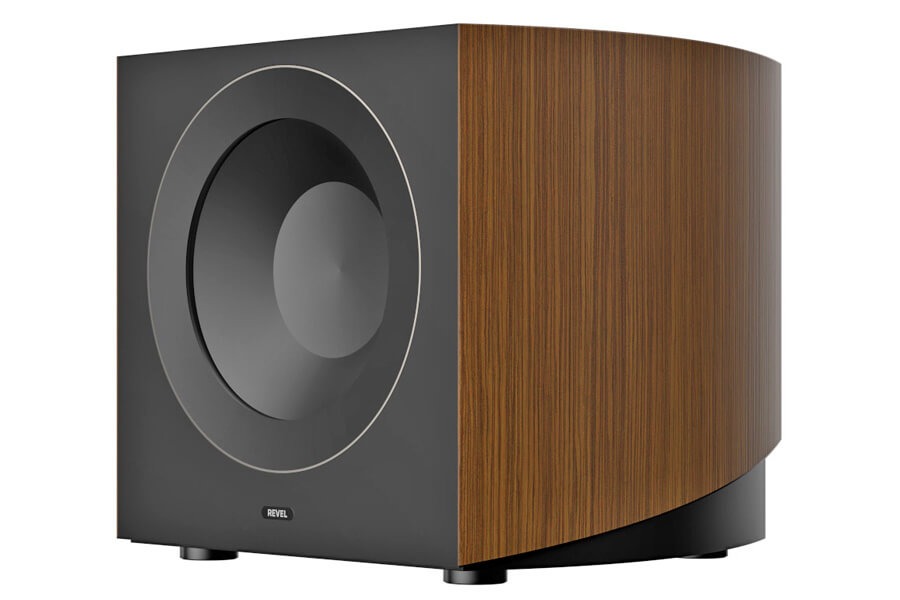
Our measurements showed a somewhat steeper low-frequency roll-off, with the response at 43Hz closer to -8dB. Listeners seeking greater bass extension and authority may want to consider Revel’s matching Performa4 B140 powered subwoofer ($2,999), which features a 10-inch driver and 750-watt RMS amplifier in a cabinet designed to complement the rest of the series.
Just remember that proper subwoofer integration involves more than selecting a crossover frequency based on the loudspeaker’s published specifications. Room acoustics, placement, phase alignment, and the measured response at the listening position all influence the final result.
The M146 is also well suited to a multichannel home theater system, thanks to Revel’s consistent approach to driver technology and tonal balance across the Performa4 lineup. A pair of M146s could handle the front left and right channels, with the smaller M145 serving as surrounds and the matching C245 center channel anchoring dialogue and on-screen action.
For larger rooms or listeners seeking greater output and bass extension, the F346 floorstanding loudspeakers are a logical upgrade for the front channels, leaving the M146s to handle surround duties. The advantage is the ability to assemble a cohesive system using loudspeakers designed around the same acoustic principles rather than mixing unrelated models and hoping the room correction software can sort everything out.
Listening
I auditioned the Revel Performa4 M146 using three very different amplifiers, beginning with the supplied Arcam A15+ ($1,499), which delivers 80 watts per channel into 8 ohms and 120 watts into 4 ohms. I then switched to my Mark Levinson No. 23.5, rated at 200 watts per channel into 8 ohms and 400 watts into 4 ohms, before bringing in a vintage Kenwood KA-3500, rated at 40 watts per channel into 8 ohms. With the M146’s nominal 6-ohm impedance, actual power delivery will depend on the amplifier and the loudspeaker’s changing impedance across the frequency range. This provided a useful cross-section of real-world amplification, from a modest vintage integrated amplifier to a powerful high-end design.

The Levinson’s rated output exceeds Revel’s recommended 200-watt amplifier limit, but that doesn’t mean it continuously delivers that power to the loudspeakers. Actual output depends on the listening level, musical signal, and speaker load, and a powerful amplifier operating within reasonable limits can provide substantial dynamic headroom.
Conversely, driving an underpowered amplifier into sustained clipping can damage loudspeaker drivers, particularly tweeters. Excessive clean power can also cause damage, so neither approach offers immunity from poor judgment. In practice, I’d rather have adequate reserves than spend an entire listening session asking an amplifier to deliver more than it comfortably can.
Of the three, I preferred the Arcam A15+ and Mark Levinson No. 23.5, both of which gave the M146 greater dynamic authority and a more open presentation. The Kenwood KA-3500 sounded comparatively flat and uninspired, lacking some of the energy and control the other amplifiers brought to the music. That doesn’t make the Kenwood a poor amplifier, but it wasn’t the strongest match for these loudspeakers. Based on my listening experience, I’d recommend 75 to 100 watts per channel as a sensible starting point for the M146, with an amplifier comfortable driving a 6-ohm load.
Tonally, the M146 is exceptionally neutral, with a mild low-frequency roll-off beginning around 60Hz that produces articulate, controlled bass without excessive weight. For acoustic music, jazz, vocals, and other recordings that don’t demand substantial deep-bass output, I found little need for a subwoofer in a modestly sized room. Placement, however, proved critical. Positioning the rear ports too close to surrounding surfaces introduced unwanted bass reinforcement, while installing the supplied foam plugs reduced the boom at the expense of some low-frequency definition.
The plugs are useful tools, but in my listening room, they softened an otherwise beautifully balanced presentation. I’d strongly recommend planning the speaker placement around the M146’s requirements rather than relying on the plugs to compensate for a compromised location.

The M146 isn’t a loudspeaker that immediately grabs your attention with exaggerated bass, forward midrange, or artificially elevated treble. Its strengths become more apparent over extended listening, revealing excellent tonality, speed, low-level resolution, and impressive dynamic range when paired with suitable amplification.
Quiet passages retain their subtle textures and instrumental detail, while large crescendos arrive with convincing impact and authority. Horns can suddenly command the room without sounding artificially aggressive, and delicate recordings remain engaging even when the volume is turned down. It’s an understated presentation that initially risks sounding ordinary, until the music becomes demanding and the Revel demonstrates just how much information it can retrieve without calling unnecessary attention to itself.
The seventh-generation Acoustic Lens waveguide contributes to the M146’s smooth, controlled treble dispersion, although proper speaker alignment remains important. I found that insufficient toe-in produced a more diffuse soundstage, with less precise imaging and a weaker sense of cohesion between instruments.
Once properly positioned, the M146 delivered excellent high-frequency detail, plenty of air, and a natural sense of space without becoming bright or fatiguing. Revel has managed to find that elusive balance between dull and piercing, allowing the tweeter to reveal fine musical information without making every cymbal crash feel like an assault on the ears.
The Bottom Line
While the Revel Performa4 M146 and MFS4 stands can be purchased separately, it’s clear they were designed to work together and are best treated as a matched set. The M146’s curved cabinet is both a distinguishing feature and a potential limitation when shopping for alternative stands. Most conventional rectangular platforms won’t fit particularly well or complement the speaker’s bowed sides. At nearly 13 inches deep, with a rear-firing bass-reflex port, the M146 also requires more breathing room than most bookshelves can provide. For those reasons, my final assessment considers the loudspeakers and stands as a complete system rather than separate products.
From a technical standpoint, the M146 follows a proven two-way design, combining a 6.5-inch woofer and 1-inch tweeter crossed over at 1.7kHz. The proprietary ceramic-coated aluminum drivers and sophisticated waveguide are carefully engineered, but the underlying principles aren’t revolutionary. Sensitivity is moderate, and the nominal 6-ohm impedance presents a somewhat more demanding load than many conventional 8-ohm loudspeakers, although actual impedance behavior matters more than the nominal rating alone. These speakers benefit from an amplifier with sufficient power and current delivery to bring out their best. Bass extension is respectable for their size, but listeners seeking genuine low-frequency authority should consider adding Revel’s matching B140 subwoofer.
On paper, that might sound rather ordinary for a $4,000 speaker-and-stand combination, but the specifications don’t tell the whole story. The M146 delivers an exceptionally clean, neutral, dynamic, and spacious presentation, with excellent transient response and a level of speed and refinement that exceeds expectations for a loudspeaker of this size. Equally impressive is its ability to maintain tonal consistency and musical engagement across a relatively wide listening area, rather than reserving the best performance for one person sitting in the exact center. In small to medium-sized rooms, the M146 can provide everything needed for serious two-channel listening, while adding a subwoofer makes it an equally capable foundation for a home theater system.
Aesthetics also deserve consideration because the M146 and MFS4 combination looks more like fine furniture than conventional audio equipment. When I was unboxing the speakers, my wife actually remarked, “Oh, those are good looking. Can we replace those big ugly things downstairs with these?” I did exactly that for the review period, and she was genuinely disappointed when the Revels were packed up and the big ugly things returned to their usual positions. For reference, those unfortunate victims of domestic criticism are my Klipsch Heresy II loudspeakers. They’ve survived decades of use, but evidently not the interior design committee.
Ultimately, the Revel Performa4 M146 and MFS4 combination makes a convincing case for its premium positioning, delivering exceptional sound quality, refined cabinetry, purpose-designed drivers and waveguide technology, and the security of stands engineered specifically for the loudspeakers. They aren’t the deepest-reaching or easiest-to-drive speakers in their class, and their distinctive shape limits placement flexibility, but those compromises are outweighed by their tonal accuracy, dynamic capabilities, and excellent all-around performance. Revel has delivered a loudspeaker that satisfies both the audiophile and the person who actually has to live with it, which is a considerably more difficult balancing act than most manufacturers care to admit.
Pros:
- Near neutral signature
- Great transient response and accuracy
- Wide soundstage / solid off-axis performance
- Premium look and finish
- Rear port plugs included for placement adjustment
- Matching MFS4 stands attach directly to speakers
Cons:
- Revel’s MFS4 stands add extra $999 to total cost
- Moderate 85.5dB sensitivity requires more powerful amplifier pairings
- Amplifier, positioning, toe-in, and room matching matter
- Rear port and 13-inch cabinet depth require placement planning
Our Ratings:
★★★★★★★★★★ Sound Quality
★★★★★★★★★★ Build Quality
★★★★★★★★★★ Design
★★★★★★★★★★ Value
Where to buy:
Related Reading:
- Castle Tintagel And Walmer Speakers Split British Hi-Fi Between Tradition And True Ribbon Technology
- Monitor Audio Silver Series 8G Debuts With 7 New Speakers For Music And Home Theater
- Sonus Faber Olympica G3 Revives The Iconic Olympica Collection With Italian Elegance And A Proper Dose Of Attitude, Con Brio