For years, the technology industry has tried to convince consumers that the future of home entertainment involves strapping increasingly expensive computers to their faces. Apple’s Vision Pro demonstrated just how impressive that experience can be, but at $3,699 and roughly the weight of a small house cat after lunch, mass adoption has remained another matter entirely.
Meta thinks the answer is not abandoning immersive entertainment but making the hardware look and feel considerably less like something borrowed from a fighter pilot.
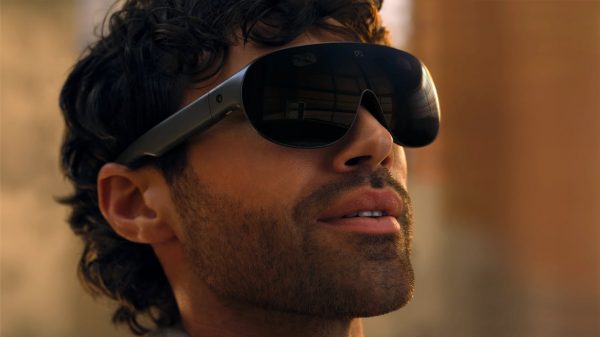
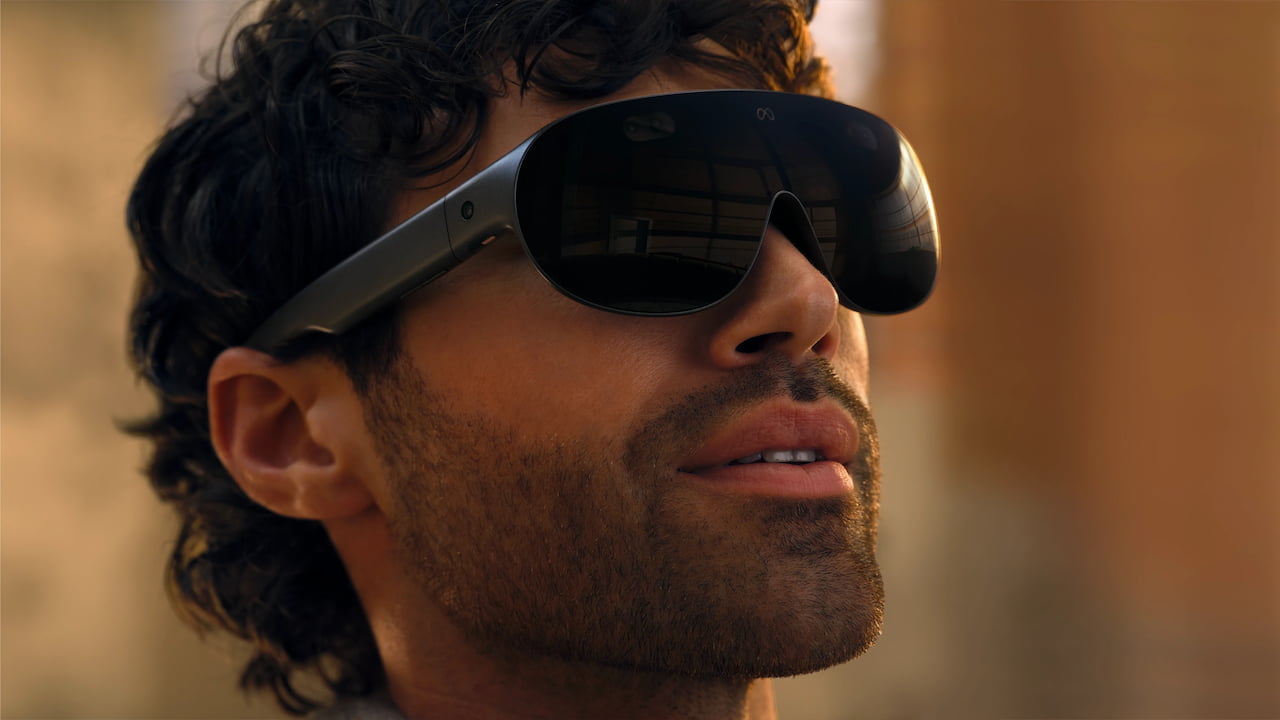
At Meta Connect 2026, the company unveiled Meta VR Glasses, a roughly 100-gram spatial-computing device with micro-OLED displays, Dolby Vision, Dolby Atmos and, most significantly for home theater enthusiasts, certification as the first IMAX Enhanced VR device. They will sell for $1,299.99 when they arrive in spring 2027.
Meta also announced a separate Dolby initiative for its everyday AI glasses. Later this year, Meta says its AI eyewear will become the first consumer devices capable of capturing and experiencing video in Dolby Atmos with 360-degree spatial sound. That puts immersive audio creation into glasses intended to be worn around town rather than inside a dedicated VR session.
Our recent coverage of Apple Vision Pro and live 8K immersive baseball looked at Apple’s attempt to make spatial entertainment compelling enough to justify its price, while Samsung’s AI Smart Glasses explored the other end of the market, where open-ear audio, cameras and AI are being squeezed into conventional-looking eyewear.
Meta is now trying to occupy both spaces.
Dolby Vision and Dolby Atmos Without the Helmet
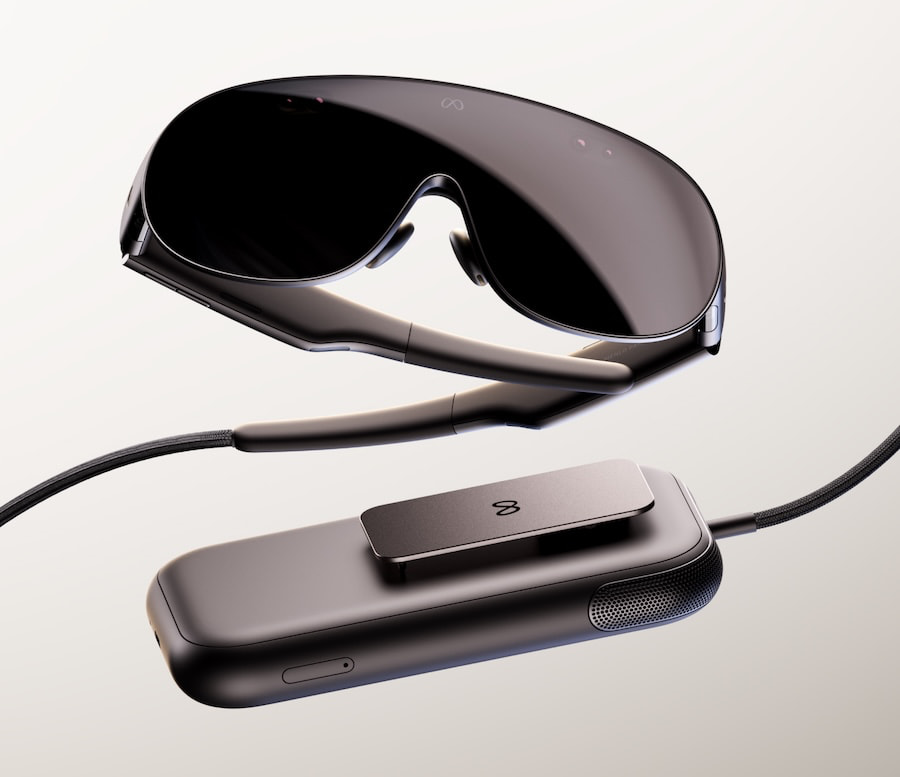
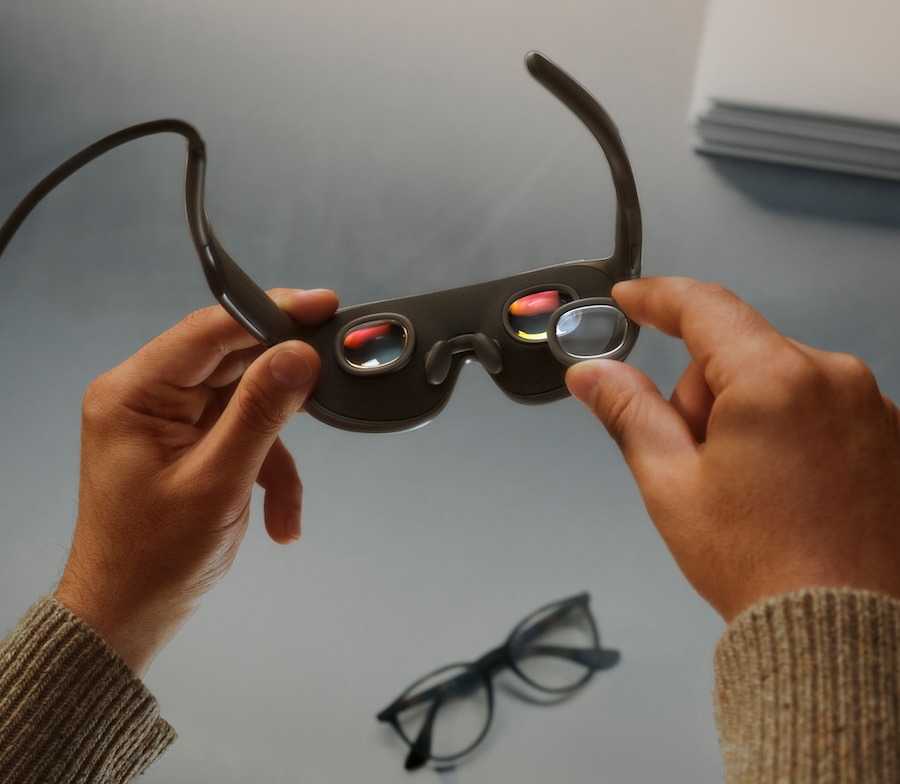
The Meta VR Glasses use what the company calls a 5K Infinite Display, built around micro-OLED panels with a claimed density of 37 pixels per degree. Dolby Vision handles HDR playback, while Dolby Atmos spatial audio is integrated directly into the frames.
That combination itself is not unprecedented.
Apple Vision Pro already supports HDR video with Dolby Vision and audio playback in Dolby Atmos, alongside Apple’s own Personalized Spatial Audio system. Anyone claiming Meta is the first company to put Dolby Vision and Atmos into a head-mounted entertainment product would therefore be getting ahead of the facts.
What is different is the packaging.
Meta says the glasses weigh approximately 100 grams, largely because the processor, battery and storage have been moved into a separate puck connected through an optical tether. The glasses handle the displays and sensors, while Qualcomm’s new Snapdragon Reality Elite processor resides in the external unit. Meta rates the puck for up to three hours of high-resolution media playback, with 45W fast charging.
Apple Vision Pro remains a far more substantial piece of headgear, and that matters if somebody expects you to wear one through a three-hour movie rather than a 15-minute store demonstration.
Moving the heavy hardware into your pocket is not exactly magic. There is still a cable and a compute puck involved. But your neck may care considerably more about where the weight resides than the marketing department does.
IMAX Enhanced Moves Into VR
The more interesting home theater development is IMAX Enhanced certification.
IMAX Enhanced has traditionally been associated with televisions, projectors and home theater hardware designed to meet performance standards established by IMAX and DTS. Compatible content can also preserve IMAX’s expanded aspect ratios, giving viewers more of the image on selected films rather than simply placing black bars around another version of the theatrical presentation.
Meta VR Glasses are the first VR product to receive that certification.
Meta says selected films will be available in IMAX’s expanded aspect ratio, effectively creating a private virtual screening environment without requiring an enormous television or projection screen. Whether that experience convinces home theater enthusiasts to trade an 85-inch television and surround system for eyewear is another discussion entirely, but this is not merely another floating virtual display.
The content strategy is also unusually aggressive.
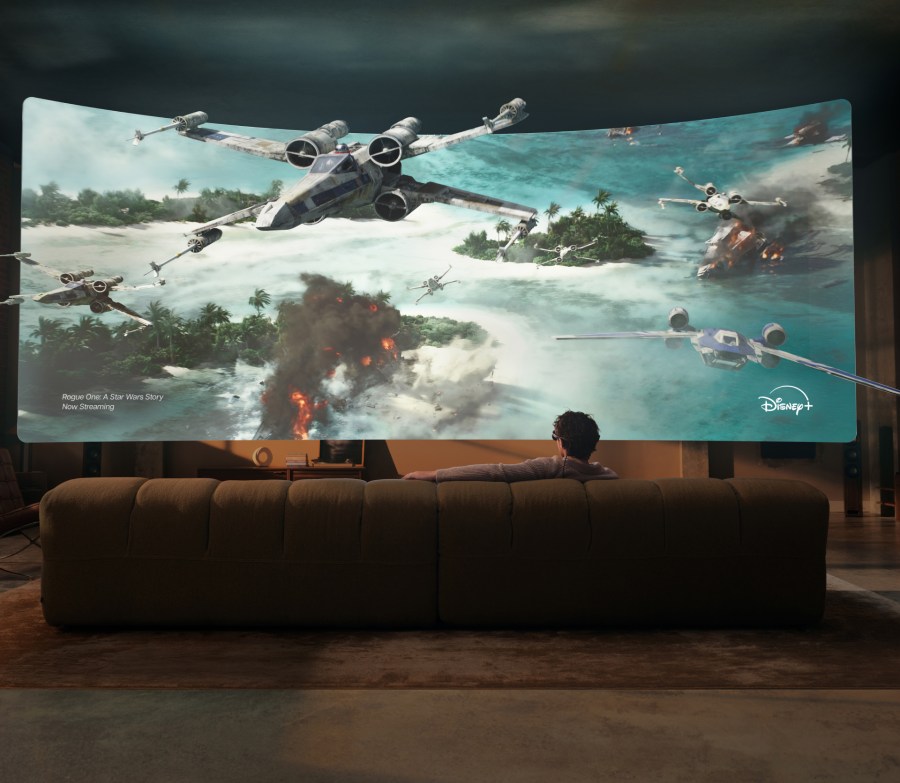
Meta says Disney+, Prime Video, YouTube, DIRECTV, AMC+, Crunchyroll, Plex, ESPN, Tubi and other services are part of the entertainment ecosystem. Peacock, HBO Max and Paramount+ are also expected to offer 3D content, while Disney is preparing 3D titles and immersive environments tied to properties including The Avengers and Black Panther.
Meta is also working with Disney and ILM on its Disney Immersive Cinema app, with enhanced presentations of films including Avengers: Infinity War and Star Wars: A New Hope. James Cameron and Lightstorm Vision are involved in bringing additional films to 3D during 2027.
Apparently watching a movie on a television is now considered insufficiently futuristic.
Live Sports Could Be Even More Important
Movies are only part of the strategy.
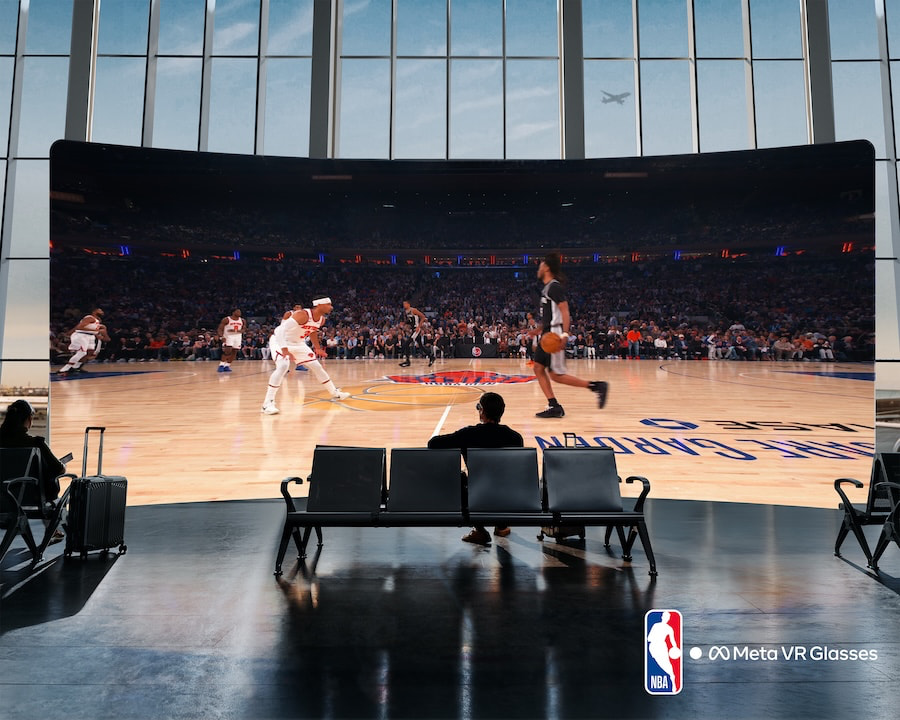
Meta says the glasses will support more than 100 immersive live U.S. sporting events per year, involving partners including ESPN, MLB, NBC Sports, TNT Sports and UFC. Its immersive sports format uses 8K streaming and 180-degree views, with college football among the first applications.
We recently examined Apple’s similar push with live 8K immersive baseball on Vision Pro, and the logic is easy to understand. A movie remains essentially the same movie whether you watch it on a projector, OLED television or headset. Sports can give spatial displays something fundamentally different to offer by placing the viewer somewhere that a conventional broadcast cannot.
A virtual courtside seat or position behind home plate is considerably easier to explain than “your Netflix screen can now be 150 feet wide.”
Meta also has one enormous advantage over Apple here: price.
At $1,299.99, Meta VR Glasses are hardly an impulse purchase, but they are dramatically less expensive than the current $3,699 Vision Pro. Neither price makes an 85-inch television nervous yet, although Meta is at least moving the decimal point in the right direction.
The Other Dolby Story Might Be Just as Important
Meta’s Dolby announcement is not limited to consuming content.
Its AI glasses are also gaining the ability to record video with Dolby Atmos spatial audio, which Meta describes as native 360-degree sound capture. Rather than recording conventional stereo audio and adding an immersive effect during playback, the goal is to preserve the spatial character of the event while it is being recorded.
That could matter more than it initially sounds.
Phones made HDR video recording commonplace long before most consumers understood what HDR actually meant. If millions of people begin recording concerts, sporting events, travel, family gatherings and questionable attempts at social-media fame with spatial audio attached, Dolby Atmos moves further away from being something primarily associated with Blu-ray discs, streaming movies and elaborate speaker systems.
There is also the unavoidable privacy issue. Camera-equipped glasses continue to create legitimate concerns about when people are being recorded, although Meta uses a visible capture LED and says disabling or covering that indicator disables camera capture on its AI glasses.
Technology may change. Human behavior remains considerably harder to upgrade.
What About Apple and Samsung?
Apple Vision Pro remains Meta VR Glasses’ already offers micro-OLED displays, Dolby Vision, Dolby Atmos, Spatial Audio, immersive sports, 3D movies and a mature spatial-computing platform, but Vision Pro is substantially heavier and more expensive. Meta is clearly betting that reducing both barriers will matter more than winning a specification contest.
Samsung’s AI Smart Glasses, developed with Google, Gentle Monster and Warby Parker, compete with Meta from a very different direction. They use open-ear audio, cameras and Gemini but do not include an in-lens display, making them closer to Meta’s everyday Ray-Ban products than its new VR Glasses. Samsung has also not disclosed support for Dolby Atmos capture or anything comparable to IMAX Enhanced.
That leaves Meta in an unusual position. It now has conventional-looking AI glasses for recording, communication and open-ear audio at one end, and a premium VR product built explicitly around movies, sports and spatial computing at the other.
The Bottom Line
The most interesting part of Meta’s announcement is not that another company has made another pair of smart glasses.
It is that premium home theater technologies are moving away from the home theater.
Dolby Vision and Dolby Atmos already escaped the dedicated cinema and moved into televisions, phones, cars and laptops. IMAX Enhanced has expanded beyond projectors and AV receivers. Meta is now trying to make those same technologies meaningful inside eyewear weighing roughly 100 grams while also turning ordinary AI glasses into spatial-audio recording devices.
None of this means televisions, projectors or loudspeakers are going anywhere. Watching a movie with friends or family while wearing individual pairs of $1,300 glasses sounds considerably less appealing than firing up a large OLED and a serious Atmos system.
But for airplanes, apartments, bedrooms, hotels and anyone who wants a 100-inch-plus screen without actually owning one, Meta may finally have a more convincing argument.
The future of home theater might still involve something strapped to your face.
At least it is starting to weigh less.
For more information: fb.com
Related Reading: